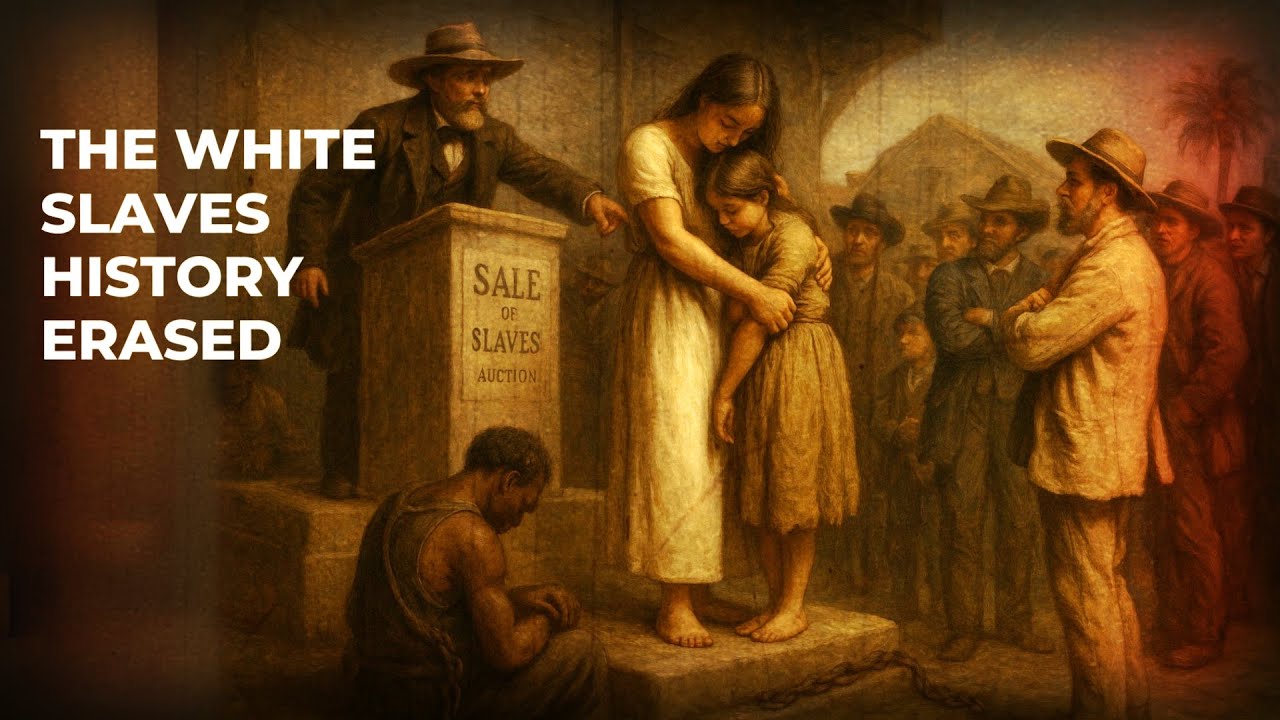
Introduction: Story You Haven’t Heard
When people think of slavery, they often picture the transatlantic slave trade that brought millions of Africans to the Americas beginning in the 1600s. In the U.S., the year 1619 is frequently cited as the “beginning” of slavery. But the truth is far older, broader, and far more complex. Long before Africans were transported across the Atlantic, slavery had already carved a brutal legacy across continents—and millions of the enslaved were white.
This is not a denial of the immense suffering caused by African slavery. Rather, it is a call to expand our understanding. From Slavic and Irish slaves to captives taken by Islamic empires and Barbary pirates, the institution of slavery has been a foundational force in building many of the world’s most powerful civilizations. And yet, many of these stories remain obscured, if not outright erased, from mainstream education.
Slavery Before 1619: The Global Norm
Long before American colonists ever planted tobacco, slavery was already a common practice in Europe, Africa, and Asia. The term “slave” itself comes from the word “Slav”—a reference to the Slavic peoples of Eastern Europe who were taken in mass numbers during the Middle Ages and sold into bondage by the Byzantine Empire, Islamic Caliphates, and various European powers.
By the 9th century, Arab traders were capturing and purchasing Slavic people to work as soldiers, laborers, and harem attendants in the Islamic world. Entire villages were raided along the Danube River and beyond. These Slavs were so prevalent in slave markets that the word “slave” essentially became synonymous with “Slav.”
Irish Slavery: The Overlooked Chapter
The Irish too faced centuries of brutal oppression, including forced deportation and slavery. Under British colonial rule, particularly during the 17th century, tens of thousands of Irish men, women, and children were sent to the Caribbean and American colonies as indentured laborers and outright slaves.
While the term “indentured servant” is often used to soften the narrative, many Irish were forced into contracts under false pretenses or had no choice at all. The conditions they endured—back-breaking labor, whippings, starvation, and separation from families—were nearly indistinguishable from those experienced by African slaves.
It’s estimated that during the 1650s alone, over 50,000 Irish people were shipped to Barbados and other Caribbean islands, where they were auctioned off like cattle. The term “redlegs” later came to describe their sunburned skin and harsh existence.
The Barbary Slave Trade Across Europe
Between the 16th and 19th centuries, North African Barbary pirates raided European coastal towns from Italy and France to Ireland and Iceland. They captured an estimated 1 to 1.25 million Europeans, selling them into slavery in the Ottoman Empire and North Africa.
These captives were used for a range of purposes—domestic labor, construction, galley rowing, and sexual servitude. In some coastal towns, entire populations were abducted, never to return. And yet, this chapter is rarely included in Western curricula.
Some historians argue that the trauma of these events created generational fear in European coastal communities. In fact, European nations eventually began paying tributes—essentially protection money—to Barbary states just to avoid further attacks.
Islamic Empires and the Slave Economy
Slavery was also deeply embedded in Islamic empires for centuries. From the Abbasid Caliphate to the Ottoman Empire, enslaved people formed the backbone of economies, palaces, and military forces. Unlike in Western chattel slavery, where racial lineage often determined lifelong bondage, Islamic slavery was more fluid. Some slaves could earn freedom, rise to power, or convert and gain rights. But make no mistake—millions suffered and died in this system.
Enslaved individuals came from many regions: Sub-Saharan Africa, Central Asia, the Caucasus, and Europe. Mamluks (slave soldiers) became powerful rulers in Egypt. Eunuchs guarded harems. Women were trafficked into concubinage. The diversity of slavery in Islamic realms is a stark reminder that bondage was not uniquely European or African—it was a global institution.
Why This History of Slavery Was Erased
Why don’t we hear about this in school? One reason is that history is often written by those in power. The narratives taught in American and European schools frequently emphasize certain sufferings while minimizing others, often to preserve national myths or social cohesion.
Highlighting the suffering of white slaves could blur the line between victim and oppressor, which complicates the dominant narrative. Furthermore, acknowledging the full scope of global slavery would mean confronting uncomfortable truths about empires, religious institutions, and economic systems that are still celebrated today.
Another factor is race-based slavery’s unique horrors. The racial caste system established in the Americas left a generational legacy of racism and inequality that continues today. This system deserves its focused scrutiny. But broadening the conversation to include other enslaved groups doesn’t diminish that history—it enriches it.
The Economic Foundations of Slavery
Slavery, in all its forms, was an economic engine. Empires were built on unpaid labor. Whether it was the Roman Empire exploiting slaves from conquered lands, the Islamic caliphates using Central Asian captives, or the British colonists profiting from African and Irish labor, the pattern is unmistakable: slavery was about wealth, control, and expansion.
Nobel-winning economist Douglass North once argued that the institutional structure of slavery enabled capital accumulation and state formation across civilizations. Whether that institution was African chattel slavery or earlier systems, the economic motive remained central. Understanding this helps explain why slavery persisted for so long and why societies were willing to brutalize millions of people—it paid.
A More Complete Narrative of Slavery
None of this is to compare sufferings or establish a hierarchy of horrors. Every form of slavery was brutal. Every victim was human. What matters is recognizing that the history of slavery is not linear or monocultural. It’s vast, transnational, and deeply embedded in the rise of human civilizations.
By acknowledging the stories of Slavic, Irish, and other European slaves alongside those of African descent, we gain a fuller picture of our past—one that can better inform our present and future.
Conclusion: Uncovering Facts Vs Myths
History doesn’t lose meaning when it’s expanded. The tragedy of African slavery in America remains a moral stain that must never be forgotten. But alongside it, we must also uncover the buried chapters—the enslaved Slavs, the red-legged Irish, the kidnapped Europeans, and the empires that thrived on their misery.
Only then can we begin to understand the true global legacy of slavery—and why its echoes still shape the world we live in today. Only by uncovering every layer of slavery’s complex and global history can we truly understand its legacy—and begin to dismantle the myths that still shape our world today.