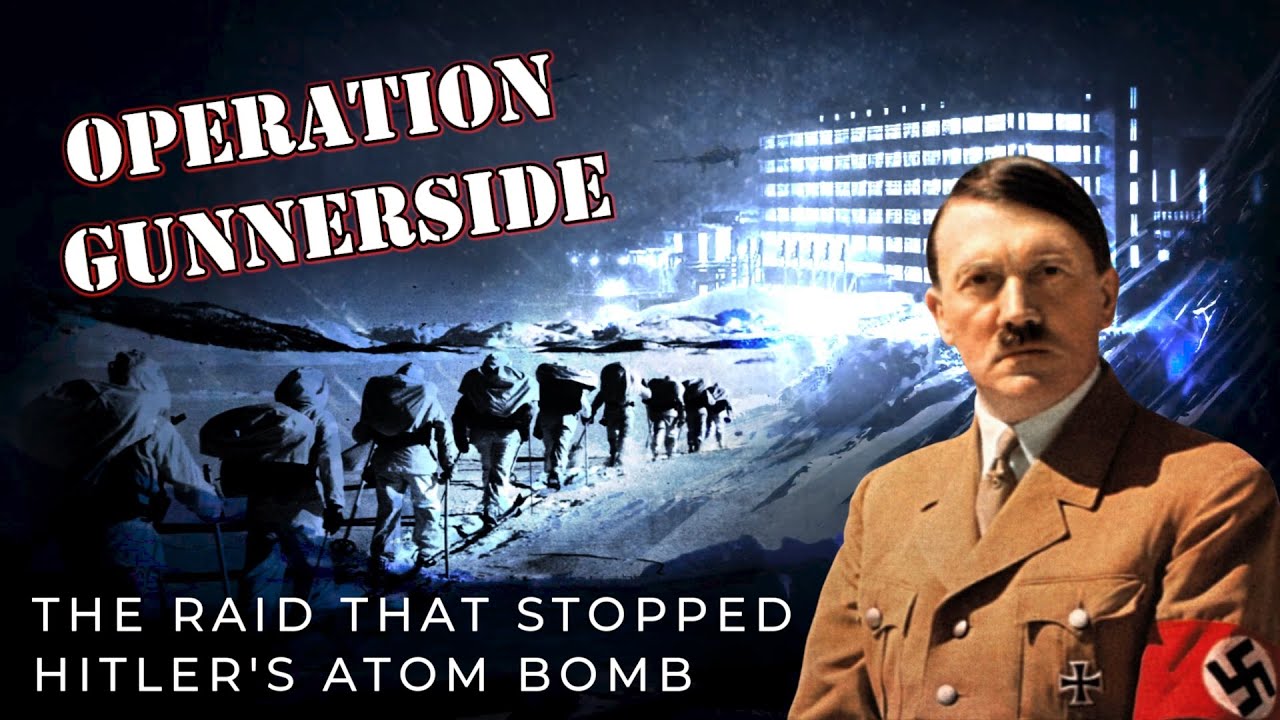
Introduction: Six Men on Skis Changed History
In the frozen wilderness of Nazi-occupied Norway, six men on skis carried not just explosives, but the fate of the free world. In what the CIA would later call “the most successful act of sabotage in World War II,” a small team of elite Norwegian commandos infiltrated the heavily guarded Vemork heavy water facility in 1943. Their mission: to destroy the heart of Nazi Germany’s atomic bomb program.
Codenamed Operation Gunnerside, this daring mission combined meticulous British planning, local resistance bravery, and immense physical endurance. The raid succeeded where larger military offensives might have failed—by slipping past Nazi patrols, scaling cliffs in deep snow, and planting explosives under the enemy’s nose. The result was a crushing blow to Hitler’s nuclear ambitions—and a critical edge for the Allies in the race for the atomic bomb.
Nazi Nuclear Threat: Why Heavy Water Worked
During the early years of WWII, both Allied and Axis scientists were racing to unlock the secrets of nuclear fission. Germany, with its rich scientific tradition and access to resources, was seen as a frontrunner. But building an atomic bomb requires more than brilliant minds—it demands key materials, including deuterium oxide, better known as heavy water.
Heavy water is essential for moderating nuclear reactions in certain types of reactors, including the design Nazi scientists were pursuing. At the time, the only significant source of heavy water in Europe was the Vemork plant, perched high above a river gorge in southern Norway, and operated by the Norsk Hydro company. Once Germany invaded Norway in 1940, the facility fell into Nazi hands, and production of heavy water began to rise sharply.
British intelligence, alarmed by the prospect of a Nazi atomic weapon, prioritized the destruction of Vemork. Winston Churchill himself approved the mission. The question was how to do it—conventional bombing was too risky, and precision was impossible from the air due to the plant’s mountainous location. The answer lay in sabotage from the ground.
Covert Plan and Skilled Elite Commando Team
Enter the Norwegian resistance—a network of patriots working in secret to undermine Nazi control. From this network, the British Special Operations Executive (SOE) handpicked a group of skilled, physically hardened men familiar with the terrain. They would parachute into Norway, endure the harsh winter, and carry out the attack from behind enemy lines.
Operation Gunnerside was actually the second phase of the plan. An earlier attempt, Operation Freshman, had ended in tragedy when two gliders crashed, killing or capturing everyone on board. The survivors were executed by the Gestapo under Hitler’s infamous Commando Order. The pressure on Gunnerside was enormous—failure was not an option.
The Gunnerside team, led by Joachim Rønneberg, a 23-year-old Norwegian with exceptional survival skills, trained extensively in Scotland before deploying. They joined an advance party already in Norway and spent weeks skiing across frozen plateaus and hiding in mountain cabins, surviving on meager rations while evading German patrols. The terrain was so remote and treacherous that the operation’s success depended as much on endurance and secrecy as on explosives.
Infiltration and Sabotage: The Night of the Raid
On the night of February 27, 1943, after weeks of preparation, the commandos made their final approach to the Vemork facility. The plant sat atop a steep gorge, accessible only by a narrow bridge and surrounded by minefields and guards. Rather than take the obvious route, the saboteurs descended into the icy ravine and scaled the sheer cliff on the other side—a feat of near-superhuman strength and stealth.
Once inside the compound, they located the electrolysis chambers where heavy water was produced. In complete silence, they placed plastic explosives with delayed fuses and then escaped into the night. The raid lasted only 30 minutes, but the explosion destroyed the critical machinery and over 500 kilograms of heavy water, setting the Nazi atomic program back by months—if not years.
Miraculously, not a single shot was fired, and not one saboteur was captured or killed. They melted back into the snowy wilderness and evaded German search parties for days, ultimately rejoining the resistance or escaping to Sweden.
The Long-Term Impact: Delaying Hitler’s Bomb
The destruction of the Vemork plant dealt a devastating blow to German hopes for a nuclear weapon. Though the Nazis attempted to resume production, further sabotage and Allied bombing raids continued to disrupt operations. Eventually, in 1944, the Germans attempted to transport the remaining heavy water to Germany—but Norwegian resistance fighters once again intervened, sinking the ferry “Hydro” on Lake Tinn, killing the cargo and ensuring none of it reached the Reich.
Historians continue to debate just how close Hitler was to building an atomic bomb. Some argue the German program was disorganized and would have failed regardless; others believe that without the Gunnerside raid, the war—and the nuclear age—might have unfolded very differently.
What is clear is that Operation Gunnerside bought the Allies precious time. It allowed the Manhattan Project, already underway in the United States, to surge ahead without fear of German competition. When the first atomic bombs were dropped in 1945, Hitler’s dream of a nuclear weapon was long dead—thanks in part to six men on skis.
A Remarkable Legacy of Heroism and Precision
Operation Gunnerside has become a symbol of resistance, courage, and strategic excellence. The bravery of the Norwegian saboteurs has been honored in books, documentaries, and films, including “The Heroes of Telemark” (1965). But beyond the dramatization lies a deeper truth: this was a mission defined by preparation, precision, and minimal force—everything special operations aspire to be.
In a world now shaped by nuclear weapons, it’s sobering to remember how close those weapons came to being developed under the Nazis. Had Operation Gunnerside failed—had even one element gone wrong—history might have looked very different.
The mission’s success wasn’t just about blowing up machinery; it was about shaping the future of warfare and saving millions of lives. Even the CIA, in a 1990s retrospective, declared Gunnerside “the most successful act of sabotage in all of WWII,” a rare acknowledgment from an agency steeped in covert operations.
Conclusion: When Sabotage Changed the World
Operation Gunnerside stands as one of the clearest examples of how a small group of determined individuals can alter the course of history. Armed with little more than courage, cold weather gear, and carefully placed explosives, the Norwegian saboteurs struck a blow not only to Nazi science but to the very foundation of Hitler’s war strategy. Finally, their mission was not just about halting a bomb—it was about protecting humanity from the unthinkable.
In doing so, they demonstrated that strategy, sacrifice, and stealth could be more powerful than brute force. They didn’t just destroy a plant—they destroyed a future that could have ended in atomic fire across Europe. Today, the ruins of Vemork stand as a museum and a testament to this extraordinary mission. And the story of Operation Gunnerside remains a reminder that history can pivot on the silent footsteps of heroes in the snow.